The First Fifty Years
The First Fifty Years
Research indicates that the first school in Boise was opened by F. B. Smith in the fall of 1863 at the corner of Idaho and Seventh Streets.
In 1864, a public school system was established in the Idaho Territory. In 1865, the territorial governor appointed J. B. Knight as the county superintendent for Ada County; and he organized School District No. 1, which included Boise City and adjacent lands.
The first public school in Boise opened in June 1865. Financial support came primarily from public contributions, as county funds were insufficient to build and maintain schools. Due to financial problems, the public school was closed from June 1866 until July 1868. In September, 1868, the citizens of Boise approved a tax levy of 5 mills for each dollar of taxable property. The money generated was used to build a school on Eighth and Washington Streets. Unfortunately, the school cost more than was anticipated, and the voters turned down a proposal to increase taxes and pay the excess building costs. Because of this, the building debt was not completely paid off until 1871.
An attempt to improve the financial condition of the District was made in 1880. Three districts were created to serve Boise City: District No. 1 serving an area bounded by Main Street on the south and Eighth Street on the east; District No. 22, serving the area south of Main; and District No. 24 serving the area west of Eighth. Increasing enrollment and increasing financial problems again caused the citizens of Boise to request a better method of providing for public schools. Thus, in an effort to strengthen the public schools and provide a graded system, the three existing districts were combined to form the Independent School District of Boise City #1.
When the legislature met in January, 1881, the citizens of Boise were determined to secure a better public school system. R. Z. Johnson, a territorial legislator, and later a trustee, drew up the bill creating the Boise District. The bill was signed by the territorial governor on February 4, 1881, and the Independent School District of Boise City #1 came into existence.
The bill, which established the Boise District, granted the District a charter, which is still in existence today. While the Charter has been amended by the legislature from time to time, many of the original provisions remain. Today, among the Charter provisions are the following which allow the Board of Trustees to:
- make rules and regulations to govern the schools;
- employ or discharge a superintendent, teachers and other employees and determine their salaries;
- determine tuition for nonresident pupils;
- adopt textbooks and determine the course of study;
- determine the length of the school term;
- determine annually the District's budget.
The most important provision is the one giving the Board of Trustees the power and authority to propose a budget, provide a public hearing on the budget, and, after adoption of the budget, and determine the amount of money needed to be raised by taxes. The right to determine the tax levy gives the District local control of its own affairs.
The first Board of Trustees for the Independent School District of Boise City #1 was composed of six men who had played prominent parts in the establishment of the City of Boise. The six men were individually named as Trustees in the House Bill which established the District in 1881. At the first organizational meeting of the Board, two of the seats on the Board were designated to be elected in 1882, two in 1884, and two in 1886.
The Charter designated that the mayor of Boise would serve as ex officio president of the Board. Officers selected from among the six Board members were vice-president, secretary and treasurer. However, the Board could select non-Board members to serve as secretary and treasurer.
The first superintendent of the Boise School District was J. W. Daniels. Daniels was born in England and came to the United States in 1851. Daniels was well-known for his outstanding teaching abilities in Latin and Greek, as well as for the rigid military discipline with which he ran the schools. Not only did students often find themselves drilling daily, but on Saturdays, the teachers were also put through a similar course of instruction.
J. W. Daniels is perhaps the best known superintendent of the period 1881-1920. However, there were 10 superintendents who led the Boise District during this time. Daniels began his association with the Boise School District in the fall of 1881. He left in February, 1882 and was first followed as superintendent by a Professor Boomer and later by a Professor George. Daniels was asked to return in January, 1883, and he remained at the District's helm until 1890, when he again resigned. From 1890-1896, the District was led by C. M. Kiggins. Kiggins attempted to broaden the curriculum as well as introduce new methods of training which focused on reason and imagination rather than rote memorization. He was an early advocate of professionally trained teachers, limited class size (less than the 70 pupils usually given each teacher), science laboratories, school libraries and kindergarten.
Kiggins left in 1896 and was followed by J. J. Allison. He had served as superintendent of schools in Ohio and Indiana. Under Allison's leadership "correlation was the key word...of the period." Subjects were correlated with music, art, literature and nature study. Specific texts were not listed in the course of study, as any text was used which included information on the subject being studied. He stressed reason and persuasion rather than corporal punishment. This was a most progressive approach; and by 1898, the Board of Trustees decided that under this approach discipline had become too lax and students too unruly. J. W. Daniels was hired as superintendent a third time in 1898 and served until 1903.
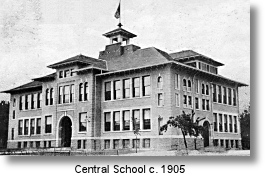
Following the school District's beginnings in 1881, it grew rapidly. The old school, built in 1868 and located on the corner of 8th and Washington, remained in use by the District until a new school, Central, was opened in 1882. This school, the first one built by the Independent School District of Boise City #1, contained 16 rooms, although not all were used the first few years. Originally, the school's estimated cost was $25,000, but the final figures were over $44,000. At the time the Board was widely criticized for building a school that was too large and too expensive. By 1893, however, Central School was serving almost 700 students and was overcrowded.
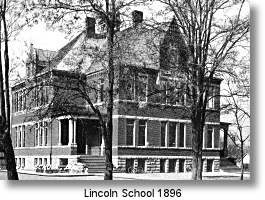
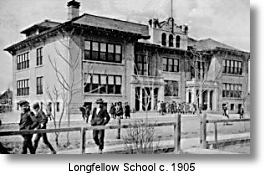
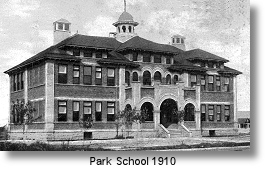
Whittier School was built in 1894 to relieve the overcrowding at Central. It was located on Fort Street between 12th and 13th Streets. The building was used as the District's administrative offices until 2001 and has since been sold, demolished, and replaced by upscale condominiums. Two years later (1896) the first Lincoln School was built. As enrollment continued growing, up to 2,364 students in 1903, additional buildings were constructed. Washington was built in 1900, followed by Longfellow and new Central in 1905-1906 (old Central School, including the block of land upon which it stood, was sold to the State of Idaho for construction of the west wing of the Capitol building in 1905). In 1910, Park School was constructed at a cost of $20,000. The building, located on a triangular block at 16th and Fairview, was used until 1949.
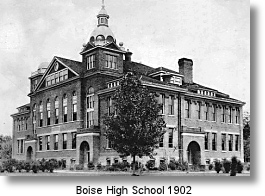
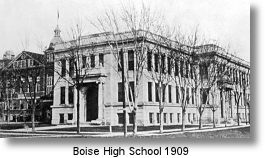
Several schools currently in use today were built during this time period. The first Boise High School was built in 1902 on the site where the central portion of Boise High is today. In 1908 the east wing was built and attached to the original structure. The west wing was constructed in 1912-13 and attached to the original building. The Industrial Arts building was constructed during 1919-20 and was used while the original 1902 building was torn down in 1921-22 and replaced with the central portion which exists today.
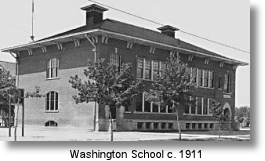
The present Washington School was built in 1911-12, adjacent to the building constructed in 1900. The necessity for two buildings was due to the fact that the style of many early school buildings, including the first Washington, prohibited additions. The original Washington School burned in 1916.
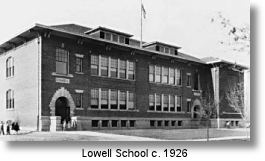
Lowell Elementary School was built in three stages. The first floor and basement were completed in 1913 at a cost of $24,972, followed by the second floor in 1917 ($3,600), and the north addition in 1926 ($25,851).
Like Lowell, Roosevelt School was built in stages; but it was completed in only one year, 1919. The basement was built by one contractor, the superstructure by a second, the plumbing by a third, and the heating by a fourth. The cost estimate was $45,000, but the actual building cost was $81,083.46.
The first unit of the present Whitney School was built in 1925-26, after the original building was destroyed by fire in 1924. The three parts of the building were again constructed by three different contractors. It cost $24,127.
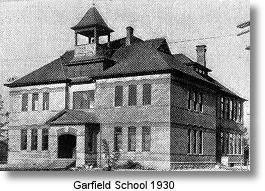
The last building constructed during the period 1881-1930 was Garfield School. It was built in 1930; and, as with Roosevelt and Whitney, involved five different contractors, each responsible for one part of the school. The total cost was $63,612.75.
While the school District's enrollment increased greatly during 1881-1930, the District's physical size also increased, due to annexations. Prior to 1881, many small, rural schools developed around the City of Boise. As Boise grew closer to the rural schools, many opted to become annexed to the larger district. In 1907 the first District, Hawthorne, was annexed to the Boise District. Following this were annexations of Garfield (1910), Lowell (1909), Collister (1922) and Whitney (1923).
An article in the October 6, 1885 Idaho Triweekly Statesman indicated that Central School was divided into four departments: 1) primary, 2) intermediate, 3) grammar, and 4) high school. Music and art were said to be taught in the first three departments in addition to the traditional courses of reading, writing (including penmanship), arithmetic and social studies. High school students studied higher math, science and college prep courses in the classics. In 1888 bookkeeping was added to the high school curriculum. The Boise District had one of only 2 high school programs during the territorial period of Idaho. The first graduating class, in 1884, was composed of Tom G. Hailey and Henry Johnson. The class of 1885 was double in size and contained the first women graduates: Hetty Cahalan, Mary Cahalan, Harry Humphrey and Philo Turner. The sizes of the graduating classes continued to increase. In 1887 there were 11 graduates, by 1900 there were 23, and by 1910 the number had increased to 72. By 1920 there were 151 graduates, and within ten years the number of graduates had reached 223.
Military training, a great love of first Superintendent Daniels, was begun for high school students in 1900. The students, with Daniels' support, organized the Boise High Cadets; and when their request for federal funding was turned down, they purchased their own uniforms and some equipment. They also encouraged an NCO from the Boise Barracks to drill them several times a week. The group grew from 30-40 members in 1900 to 70 in 1902. During World War I, the group disbanded, but reorganized in 1918. In 1919, Congress expanded the funding for military groups so that high school groups could receive money. Thus, the Boise High Cadet Corps began in the spring of 1919, with 60 boys under the direction of Lt. Col. John E. Wall.
The school board minutes of August 4, 1903, listed the following curriculum as the one adopted for the 1903-1904 school year:
- 9th grade: Algebra, American Literature, Civics, Physical Geography, and English Grammar or Latin
- 10th grade: Algebra, Rhetoric, History, Zoology, and Botany or Caesar
- 11th grade: English Literature, Physics, Plane Geometry, Astronomy, and English History or Cicero
- 12th grade: Chemistry, Geology, Solid Geometry, American History, Economics, Advanced Arithmetic, and Critical Literature or Virgil
Courses added to the high school curriculum between 1904-1908 included cooking, sewing, manual training and music. Marguerite Nolan (Mrs. Herbert Lemp) is credited with beginning the domestic science courses at Boise High.
During the period from 1908-1915, the home economics program and the manual arts program were enlarged in scope. Other curriculum changes included the first free night school for high school dropouts and an expansion of the original classical curriculum to include the previously mentioned courses, plus stenography and typewriting.
The first programs for students with special needs were established in 1896 at the then newly constructed Lincoln School on the corner of 4th and Idaho. The school was patterned after the Emily Griffeth School in Denver, which was the first school in the west for students with special needs. The school soon became known as the Lincoln Opportunity School with four full time teachers instructing students in grades 1 through 8. In the early days of Lincoln Opportunity School, boys and girls were taught separately. As Lincoln School was developing and expanding service, other schools were following suit. In 1924 an Opportunity Room was established at the old Whittier School for students who were not benefiting from regular school programs.
Another important program was developed in 1924. The District, in cooperation with the local Red Cross Chapter, established a dental clinic. The District furnished the rooms, and the Red Cross furnished the equipment. Local dentists volunteered their time to conduct examinations. In 1927 a dental hygienist was employed.
The period of 1881-1930 saw the introduction of activities as well as courses. Athletic activities for boys began in the 1890's. The first girls basketball team was begun in 1907 and was composed of seven members. The 1907 Boise High School yearbook stated that "...it was an honor to be defeated by such a team." The Boise High Courier was first published in 1900 as a monthly magazine. It later became the school's yearbook. During the 1900's, the Boise High Highlights was first published as the newspaper of the Associated Student Body.
The first radio station in Boise, KFAU, was started at Boise High School. The operational equipment was located in the basement of the high school, and a transmitter was placed on the roof. The station operated until 1928, when the radio program was discontinued.